

The Industry’s Need to Reshape Optical Fibers for Scale-Up AI Data Centers

As AI data centers continue to scale, the limitations of traditional active electrical cables (AECs) are becoming increasingly apparent. Electrical interconnects struggle to meet growing demands for bandwidth density and transmission reach, driving the industry to transition toward optical cables as the next-generation solution.
RVi’s initial approach leverages the mature and reliable supply chain of 850 nm vertical-cavity surface-emitting lasers (VCSELs) and couples this wavelength into existing multimode optical fibers. Optical fibers provide an efficient transmission pathway that enables data—previously constrained by electrical losses—to travel significantly longer distances. While conventional AEC solutions are typically limited to 3–7 meters, optical fiber-based links can readily extend transmission distances to 30 meters or even 70 meters using glass fiber cores.
The operation of optical fibers is governed by fundamental principles of light refraction and reflection. When light passes from one medium to another at a specific incident angle, total internal reflection occurs if the angle exceeds a critical value defined by Snell’s law. A key requirement for this phenomenon is that light must propagate from a medium with a higher refractive index to one with a lower refractive index.
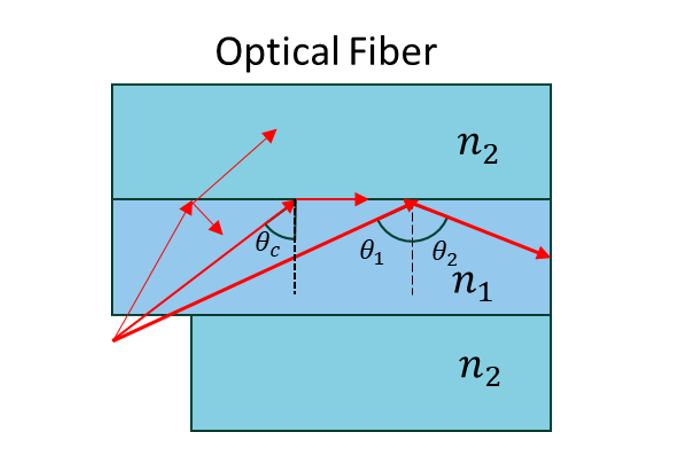
According to Snell’s law:

When the refracted angle reaches 90 degrees, the equation simplifies to:
This condition defines the critical angle at which total internal reflection is achieved.
By maintaining total internal reflection within the fiber core, optical signals can propagate with very low optical intensity loss, ensuring reliable delivery of data to the photodiode at the receiver for signal reconstruction. RVi currently employs OM3 and OM4 multimode fibers, which exhibit a measured optical loss of approximately 3 dB per kilometer. In parallel, we are actively developing solutions that operate at longer wavelengths, such as 1060 nm, to further extend transmission distances.

Looking ahead, continued innovation in optical fiber design will be essential to support highly reliable, VCSEL-based optical engine solutions. Advancements in fiber performance will play a critical role in enabling scalable, energy-efficient optical interconnects for next-generation AI infrastructure.